Posted by Anita on 05.31.10 11:05 PM
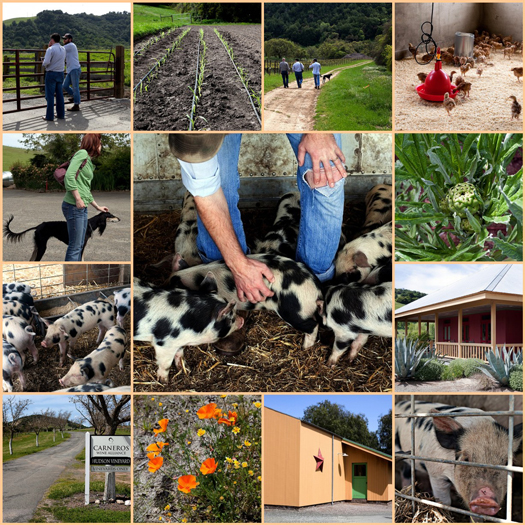
Last month, our friend Morgan Weber — who runs Revival Meats in Houston — came to town to talk shop with his Bay Area cohorts. He visited a who’s-who list of our local charcuterie shops and sustainable butchers, hitting up Fatted Calf, Boccalone, Bi-Rite Market, Prather Ranch, and a number of other carnivore havens. I don’t want to put words in anyone’s mouth, but I think it’s safe to say that one of the highlights of his trip was the Saturday afternoon spent at Hudson Ranch, a trip Morgan generously invited us to share.
Ranch manager Scott Boggs escorted us around Hudson’s spread, showing us both their hog and poultry sites, as well as their CSA vegetable farm. Hudson is primary known as a winery — their wines are cult favorites — but Scott came on board 2007 specifically to manage the edibles at Hudson Ranch. A veteran of The French Laundry’s garden operation as well as its kitchen, Scott brings true farm-to-table experience to the ranch; he understands what chefs want and need to see coming through the kitchen door.
We started our tour near the ranch offices, just off the main Carneros Highway. Our first stop — as Morgan was in town specifically to see them — was a pen full of dalmatian-spotted piglets, a litter born from an Old Spots sow mated to a boar of wilder heritage. Anyone with lingering doubts about how ethical meat can be would have been happy to see what we saw: A spacious, shaded pen with lots of room for piglets to play and plenty of room for their mama to move around (though she kept her snout in the trough during our whole visit), plus a view across to a beautiful lake and rolling hills beyond.
Down the road a piece, we got to peek in on a gaggle of chicks: babies in their boxes, and adolescents in their indoor roosts. By now, some of these birds are out on pasture, scratching away and fattening up for Chez Panisse and other local tables. A little further away, we trekked down a winding dirt road to check in on the CSA fields, where the first corn and tomato seedlings were already reaching for the sun.
We’re lucky that we were already eating lots of Hudson Ranch-raised food, even before we had any idea who they were. Hudson Ranch supplies Fatted Calf with some of their pork and poultry. (They also sell chickens and game hens to many restaurants you’d recognize.) The pig from Cameron’s birthday pig-roast last year was a Hudson, as were two of our last three Thanksgiving turkeys. Hudson also makes an award-winning olive oil, and they stock the produce shop at the Oxbow Public Market in Napa, in addition to supplying their CSA members’ weekly produce boxes.
One of my new year’s resolutions for 2010 was to eat more food grown by people we know. It wasn’t just born from a desire to eat more local food — we’re pretty much doing that all the time, now — but out of the realization that the closer we are to the source of our meals, the more satisfying they are for us. Even before last year, when we had the pleasure of picking our own tomatoes at Mariquita Farm, we were well acquainted with Julia, our Thursday night “casual CSA” farmer. And of course we had the privilege of helping Alexis and Eric after their devastating fire at Soul Food Farm, where our CSA chickens and eggs start out. We’ve toured Marin Sun Farms with Dave Evans, and seen where much of our beef, chicken, and pastured eggs come from.
Every time we open a quart jar of tomatoes, I’m reminded of the drive we took down to Watsonville and the morning we spent picking the very ripest Beefsteaks. When we enjoy a perfect omelette, a crisp roast chicken, or a plate of freshly dug new potatoes, we take a certain pride in knowing where it the ingredients came from, and in doing right by the food and the farmers who grew it. It may seem corny, but when we take a particularly delicious bite of food, we often thank the farmers, the ones who bring our daily feasts. I’m glad we can add Scott and his beautiful ranch to our roster of farmers we know.
Hudson Ranch
5398 Carneros Highway
Napa, California 94559
(by appointment only)
707-255-1455
http://www.hudsonia.com/hudson-ranch.html
@HudsonRanch on Twitter
—–
FTC disclaimers:
Morgan and Stacey Weber are friends of many years; Revival Meats is an editing client.
Hudson Ranch sent us a bottle of olive oil earlier this year as part of a media promotion.
farms & farmers, Napa & Sonoma
3 Comments »


Posted by Anita on 11.11.08 1:19 PM
 When a chef friend tells you that every dish she tasted at a new restaurant ran from “extraordinary to just great”, you take note. When a second foodie friend exclaims that this same place offered “one of the most enjoyably pleasurable meals I have had in some time”, you start to get excited. And when a big-paper critic fawns that this restaurant “has a soul, evident from head to tail,” you move that place to the top of your must-try list. Restaurant Eloise, the new-ish Sebastopol venture of Ginevra Iverson and Eric Korsh — former sous-chefs at NYC’s much-lauded Prune — clearly has a diverse and well-subscribed fan club.
With this much positive buzz, we were surprised to have our pick of tables, even for a same-day Saturday-night reservation. When we arrived, the dining room was nearly empty, but it glowed with the light of candles on each table, and we were warmly welcomed by the host and our waiters. I knew the setting would be pretty without being precious; Shuna’s gorgeous photos told its story so well. We were charmed by Eloise’s simplicity: Whitewashed walls adorned with mismatched gilt-framed mirrors and botanical prints, and a tiny bud-vase on each table filled with flowering herbs.
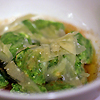
As we got settled, we were presented an amuse on a pretty toile-print plate: Crostini topped with a frothy mousse of a “trifecta” (said the waiter) of poultry livers, drizzled with olive oil and sprinkled with chives. I’m not terribly fond of liver, but if it tasted like this all the time, that would change.
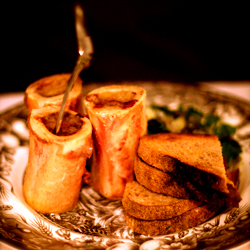
Every starter on the menu was appealing; I settled on an order of fresh local spot prawns, a special offering. Cameron opted for the marrow bones, a dish he can never turn down. A trio of large prawns arrived, roasted and simply dressed with lemon and oil; one of the three was bursting with coral. Though perfectly fresh and firm-textured, the prawns were a little bland, and I wished I’d followed my initial urge to try the truffled mushroom toast instead.
The marrow bones were generous and tasty, although the quizzical and utterly awkward use of an upended teaspoon handle as serving implement caused some ill-disguised grumbling from the other side of the table. An accompanying St John-style parsley salad was a tad unorthodox — the kitchen flagrantly disregards Fergus Henderson’s dictum regarding the sparing use of capers, but the end result was delicious.
Unfortunately, we didn’t enjoy our main dishes nearly as well. The much-raved-about ricotta-and-chard gnocchi were as decadent as promised, swimming in a pool of sage brown butter. But they were so monotonously rich that I could barely manage more than three or four bites.
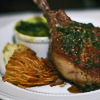
Cameron’s veal chop was a good news/bad news story. The accompanying creamed spinach and sorrel was a delicious riff on the steakhouse classic, but the billed “crispy potato” turned out to be a ho-hum hash-brown. The chop itself — ordered medium-rare — came out with a glorious crust but a nearly raw center. Sent back to the kitchen, it returned a little closer to rare, still not as ordered, and messily propped back on the same plate with its now-cold sides. Maybe this quick fix would be OK at a neighborhood joint, but for a $32 entree at a white-tablecloth destination restaurant, it seemed ungracious.
And even though we’d specifically saved room, there was nothing on the dessert list to tempt us. The sweets seemed dropped onto the menu from a great height, with little thought to seasonality or diversity. After 7 days, I can only remember one of them: a baba au rhum.
All in all, Eloise seems like a place with promise, but a little unpolished… especially for a place where you can spend $13 for starters and $30 for mains without batting an eye. It’s likely that the missteps we experienced were an anomaly, given the heaps of praise we’ve heard from others. And the service was lovely enough that we left feeling hopeful, rather than disgruntled. We hope Eloise finds her groove soon.

Restaurant Eloise
2295 Gravenstein Highway South
Sebastopol, CA 95472
707.823-6300
Napa & Sonoma, restaurants
Comments Off on Meeting Eloise
Posted by Anita on 08.24.08 6:08 PM
 Aside from grinding and stuffing a few pounds of sausage now and then, curing meats is a task — much like beer-brewing and bread-baking — that I am more than happy to leave to the experts. Don’t get me wrong: I love getting up to my elbows in fatty meat and curing salts and aromatics. But when you have local artisans like Fatted Calf, even the most enviable meat-curing skills become obsolete.
To say we’re big fans of the work that Taylor Boetticher, Toponia Miller, and the rest of the Fatted Calf crew are doing is a huge understatement. We’ve spent the last two years gleefully eating our way through their entire offering, and there’s barely a thing we’ve tried that didn’t make us squeal with delight. Their smoky bacon is heaven in a frying pan, their rind-on pancetta is nothing short of funky-fabulous. Their beef jerky is addictively awesome, and their pâtés and terrines are a slice of savory joy. Their sausages — especially the Toulouse and the andouille — are light-years better than anything we make at home.
So when we heard that Piccino — a jewelbox cafe/restaurant in Dogpatch, the next neighborhood over — was hosting a supper featuring Fatted Calf products, cooked jointly by Taylor and the Piccino crew, we reserved two slots as fast as our little fingers could email the RSVP.
I should add at this point that Cameron and I have mostly given up on these sorts of one-night foodie extravaganzas. It’s too easy to get your expectations set impossibly high, or to calibrate each bite to the fantastic sum of money you’ve spent. We went against our usual stance this week for two reasons: Piccino is precisely the kind of restaurant we love — a cozy neighborhood space with a short, ingredient-driven menu that actively supports local farmers and food artisans — and because we can’t get enough of Fatted Calf.
On the night of the meaty meal, we gathered on the sidewalks in front of Piccino’s corner doorway. Happy gaggles of diners shunned the interior and spread down each street, glasses of deep-pink rosé in hand as we savored a rare, warm San Francisco summer evening. We hung back for another reason, too: We weren’t sure how we would all fit into the small dining area. Eventually, we were called to the communal table, so we squeezed onto the banquette, tried not to knock elbows with our neighbors, and wondered just what we’d gotten ourselves into.
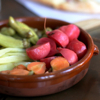
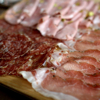
We needn’t have worried. By the time the second course (and third glass of wine) rolled around, we’d been utterly, completely won over. There were some service mishaps — one end of the table missed out on a pizza that somehow got misdelivered not once but three times — but these were forgivable, almost-funny oversights. We were chatting with our neighbors quite amiably by this point, companionably sharing platters of assorted charcuterie and a casuela full of lightly pickled, jewel-like vegetables.
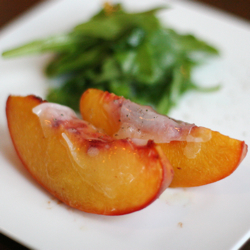
 For the next course, we each got our own plates… a wise move, as I suspect that riots might have broken out otherwise. Who could be trusted to share a perfectly ripe Hamada Farms peach, draped with tissue-thin lardo, accessorized with a bitter-crisp salad of baby dandelion greens? (Hint: Not me.) Next up came an inspired riff on pork and beans: Shelling beans cooked to a toothsome creaminess, garnished with crisp-chewy pork rillons and melted Early Girl tomatoes.
Then, the main course platters filled the table: unctuous smoked lamb; bowls of fregola with charred young onions and baby potatoes; marinated eggplant with roasted gypsy peppers and capers; golden beets with their own sauteed greens, tarragon, and ricotta salata; and an out-of-this-world mint chutney. After hours of joyful din, passed platters, copiously refilled glasses, and a bevvy of spontaneous toasts to the kitchen, we were struck dumb. Everyone, all down the table, sat nearly silent, in awe of the fabulous food.
We hardly had room for dessert, but we bravely soldiered on. Plates of figs in various stages of caramelization arrived, dolloped with sheep’s milk fromage blanc, decorated with strawberries, and accompanied by an almond tuile. We lingered in the candlelight, talking with new acquaintances and exchanging plans to run into one another at the market next weekend. When I looked at my watch, I was stunned to see it was nearly midnight: We’d passed 5 hours in a magical space that somehow seemed to have grown larger, filled with conversation, light, and laughter.
To me, the most amazing thing about the whole meal was that (with the exception of the fregola and the wines) everything we ate came from within our local foodshed. The lamb was grown on the same Napa homestead as the shelling beans, both brought to Taylor as part of an over-the-fence trade with a prolific neighbor. Like all of Piccino’s regular meals, the vegetables and fruits for the evening were sourced from local farmers; many of their names graced the menu.
Although this was a one-time event, we’re already looking forward to going back to Piccino often. (I’ve stopped in a few times for a glass of wine and a bite to eat after picking up my Mariquita mystery box, but I haven’t really tried a whole meal there. That’s going to change.) And, if you’re in the mood for an epic food evening like ours, check out the Piccino schedule; there’s another meat dinner scheduled with RoliRoti’s Thomas Odermatt in October, and a mushroom feast with Far West Fungi in November.


Piccino Café and Pizzeria
801 22nd Street
San Francisco, CA 94107
415/824-4224
Fatted Calf Charcuterie
Oxbow Public Market
644-C First Street
Napa, CA 94559
707/256-3684
– Also sells most products at:
Berkeley Farmer’s Market
Saturday, 10 to 3
Ferry Plaza Farmer’s Market
Saturday, 7:30 to 2
locavore, meat, Napa & Sonoma, One Local Summer, restaurants
10 Comments »
Posted by Anita on 03.20.08 11:44 PM
 If you ask Cameron what his favorite cold-weather meal is, you might be in for a surprise. It’s not Thanksgiving turkey with all the trimmings. It’s not even a big prime rib, with plenty of leftovers for his beloved beef-and-bleu sandwiches. No, the thing my Scots-Irish husband loves best when the nights are long is New England Boiled Dinner — better known as “corned beef and cabbage” — with a hearty dollop of horseradish cream and an imperial pint of stout to wash it down.
Like most folks, we’ve reserved this marvelously meaty meal for St. Patrick’s Day feasts. But given how cheap it is, and how much we enjoy it, I’m not entirely sure why we don’t trot it out regularly. Perhaps we got in the habit back when it was difficult to find corned beef during the rest of the year. But the last few winters, we’ve taken to curing our own brisket, so getting our hands on nice corned beef isn’t so much of a problem.
I know there are at least two of you who know our little secret: Home-cured corned beef only sounds impressively arcane; it’s actually about the easiest thing you can cure at home. The only thing you need is a 4-to-6 pound piece of brisket — point cut, preferrably — plus a few easy-to-find spices and a week’s forethought. And if you use a dry cure like the Cooks’ Illustrated recipe [link removed*] we often follow, rather than the typical immersion brine, you don’t even need a lot of fridge space. Honestly, we’ve got to do this more often… if only for the crave-inducing leftovers.
 This year’s brisket came to us from Marin Sun Farms, and a glorious specimen it was. For the accompaniments, we wandered the Ferry Plaza market and rounded up a Catalan Farms cabbage, two pounds of Little’s potatoes, a bunch of Star Route Farms carrots, a pile of Dirty Girl boiling onions, and a couple of rutabagas from Heirloom Organic. Imagine our surprise as we walked by the Happy Girl Kitchen pickle stand on our way back to the car and noticed they were selling prepared horseradish! (Yes, it was local — grown at Tairwa Knoll Farms and processed in Santa Cruz County — and delicious.) On the way home, we popped by our local microbrewery, 21st Amendment, and picked up a growler of their oyster stout. Ah, it was the easiest 100% local meal of the month, to be sure, and definitely one of the tastiest.
The rest of the fortnight was full of other tasty tidbits, including six meals at restaurants that wear their locavore menus on their sleeves. You’ll recognize lots of old standbys in the list below, and a pair of newcomers. Let’s just say that Conduit seems to be still working the kinks out of their kitchen; they’ve only just opened, so we’ll keep mum. On the other hand, Ubuntu is old enough to know better. I wish we had loved every bite at this nationally fawned-upon Napa newcomer, but — as our friend and dining companion Cookiecrumb detailed elsewhere — the inventive flavors and gorgeous ingredients were so oversalted as to be nearly inedible. Ah, well… they can’t all be Range, I suppose.
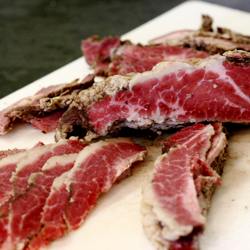
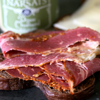
Mercifully, we did not return home hungry. There were plenty of other delicious things we discovered on our Napa field trip, including a to-die-for packet of pastrami (from Fatted Calf’s gorgeous new shop at the Oxbow Market) that had us happily gorging on sandwiches… even for breakfast. And we also discovered another secret ingredient that we’ll share more about in our next Dark Days installment.
Dark Days Ticker — March 1-15
– Dark Days dinners at home: 8 out of 15
– Locavore dining-out: Range, Primavera, ubuntu, O Izakaya, Two, Conduit
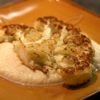
– New recipes: Jamie’s stuffed potatoes, Hugh’s milk-braised pork, cauliflower steaks
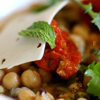
– Old faves: corned beef & cabbage, egg drop soup, bean salad, Waltuck‘s chicken paprikás, grilled rib-eye
– Freezer fodder: golden veggie bisque, potstickers, chili verde enchiladas, oxtail ragu, bolognese sauce
New local items in the pantry:
– Straus Creamery cream-top milk (2% and whole)
– Marin Sun Farms point-cut brisket
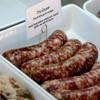
– Fatted Calf pastrami (available at their Napa store only, alas!) and bierwurst
– Little‘s “all blue” potatoes
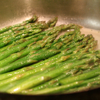
– Zuckerman’s asparagus
– Happy Girl Kitchen Co. prepared horseradish
– Andante butter
– 21st Amendment Oyster Stout (brewed with Hog Island oysters!)
– Carmel S&S Syrah (thanks, Lauren!)
– Bartholomew Park Cabernet
—-
* Edited to add: We removed the link to the Cook’s Illustrated recipe in July 2008 in protest of their bullying tactics.
beer, Dark Days challenge, holidays & occasions, locavore, meat, Napa & Sonoma, restaurants
12 Comments »
Posted by Anita on 01.13.08 2:08 PM
 Suffice to say that we had such a relaxing time on our vacation that it’s taking us an inordinately long time to get back in the swing of things. We’ve been home nearly 2 weeks now, and I am finally getting my head out of the clouds long enough to tell you about all the gorgeous food we ate.
Our 10 days away — in a little cottage in the foothills above Napa Valley — were incredibly relaxing. We brought along two coolers full of food from the farmers market (our landlord eyed the back of our car and quipped, “You know, we do have grocery stores here…”) and we spent nearly every day sitting by the fire, catching up on our reading, and cooking amazing food.
The day we drove up, we bought a pair of enormous Dungeness crabs from Shogun fish on their last market day of the season. The first night in our little cottage, Cameron picked the crabs and we sauteed the meat in Spring Hill Farm butter along with some zest from our backyard lemons and a few slices of green onions. Served over Eduardo’s linguine, with a salad and a split of Schramsberg sparkling wine, it was the perfect settling-in meal.
Of course, there was plenty of leftover crab meat! The next day, we turned part of it into crab omelettes for brunch, then mixed the rest into a sumptuous batch of fondue mac-and-cheese. Monday night, we whipped up a 100% local batch of Jen’s chicken cacciatore with an heirloom chicken from Prather and some Far West Funghi chanterelles, served over Full Belly Farm polenta with a bottle of Calistoga Cellars Zinfandel.
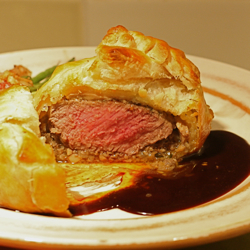
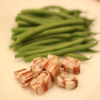
Tuesday night was Christmas supper: Mini beef Wellingtons! Prather Ranch filet mignon wrapped in puff pastry with a slice of Fatted Calf foie gras and duxelles made from Far West cremini mushrooms, Spring Hill butter, and Straus cream. On the plate: A sauce of red-wine-infused demiglace (homemade from Prather bones) and a side of Iacopi green beans quick-braised with Fatted Calf pancetta. We drank a bottle of Cabernet from Mount Veeder Winery, just a few miles down the road from our cottage.
Wednesday night, we turned to our usual lazy-day standby: Pasta Bolognese with a big green salad. Thursday we took the night off from kitchen duty, and headed down the hill for a gorgeous sushi-fest at Go Fish. By Friday, we were ready to cook again: We pulled the last of our homemade spiral sausage out of the freezer and served it along with cauliflower soup made from farmers market veggies and a mixture of orphan pieces from the local cheese plate we’d been nibbling all week.
Saturday night Cameron made an improvised braise of Prather beef cheeks, with homemade beef stock, home-canned tomatoes, and herbs from the garden. Served with more Full Belly polenta and some Ella Bella broccoli rabe, it was the perfect supper for the chilliest night of our trip.
Sunday night, we began prepping our traditional New Year’s cassoulet. While the stovetop was occupied simmering Rancho Gordo beans, searing Toulouse sausages, and cooking off Fatted Calf duck confit, we used the oven to roast a most gorgeous Range Brothers pork rib roast. An unorthodox recipe for potato gratin — started on the stovetop and finished in the oven while the roast rested — turned out beautifully… a perfect showcase for Little’s potatoes, Bellwether Farms cheese, and Clover dairy. We usually roast our Brussels sprouts, but because our baby oven couldn’t accommodate a roast and a side dish, we tried a new-to-us method: Sauteeing the shredded sprouts in rendered pancetta fat, and adding the crisped pork back to the finished dish at the end. (We loved it so much, we’re having it again tonight.)
Monday night — New Year’s eve — meant it was finally time to break into the cassoulet that had been tempting us with its luscious smells for the last 24 hours. A rough-but-tasty bottle of Pinot Noir and a big salad were all we needed to round out its delicious pork-infused goodness.
Packing the next morning was almost impossibly hard; our little kitchen had served us so well for our 10 days away! Unlike most rental houses, this one was well stocked with high-end cookware and thoughtful staples (organic eggs and Bouchon pastries awaited us our first morning). But the ultimate luxury was having the time to putter in the kitchen all day, every day. The space was cozy, and the equipment a bit spare, but it was such a treat to forget about the office, the phone, and all of our usual distractions for a few days and cook together.
We planned all along to keep up with the Dark Days challenge while we were gone, but looking back over our photos, we were surprised at just how well we’d done. With the exception of cocktails, a few lunches out, and our one in-town dinner, everything we ate and drank during our trip came from local sources. Getting to the 90% local, five-nights-a-week mark has become pretty achievable for us on a regular basis. It’s comforting to know we could get to 100% local — given unlimited time to plan, to shop, to cook — even if it’s not something we’re able to do in the workaday world.


Now, in theory, the Dark Days challenge wrapped up at the end of last year, with an optional extension into 2008. We’re having such a ball, we’ve decided to continue with the challenge, along with more than 20 other participants. Because our hostess, Laura, is in the midst of moving her house (and her chickens!), official wrap-ups will taper off to every two weeks.
Because it’s a new year, we’re going to make some changes to our own ground rules, too. Here’s our revised game-plan:
- We will continue to cook locally as often as we can, with a baseline of two dinners per week made from 90% local ingredients.
- We will write about
at least two meals a week made with as many local ingredients as we can source. our locavore adventures regularly, but we’re going to dispense with the litany of meals and sources, as it’s getting rather repetitious and a bit boring for non-locavore readers. We WILL talk about new pantry items, new farmers we’ve discovered, and recipes for in-season items within our foodshed.
- Local for us will be a 100-mile radius for produce and a 200-mile radius for protein. We will try to keep our protein within a 50- to 100-mile radius at least twice a week. Strong preference will be given to items purchased directly from farmers at market rather than retail. Our protein will include pastured eggs, poultry, and pork, as well as grass-fed beef. When grass-fed is not available or not appropriate, we will use 100% humanely raised, pastured beef. (I find grass-fed beef too gamey in grilled or stir-fried preparations, but for braises and stews, it’s our new default.)
- We’re making the usual ‘Marco Polo’ exemptions for seasonings.
We’re also making exceptions for flour, dried pasta, white rice, and polenta — we have no local sources of these ingredients, and man does not live by potatoes and bread alone. We will try to source baking ingredients locally, but I don’t expect to find much beyond nuts, and I won’t go through the holidays without baking. (We’ve found local sources for all of our grains.)
- We’ll try to limit processed and prepared foods to those produced within a 50-mile radius. We’ll try to determine how much local ingredient sourcing they’re doing, and talk about it in our posts.
- We’ll continue with the challenge through the end of
the year, and then re-evaluate on New Year’s Day along with other participants. March.
Dark Days challenge, locavore, Napa & Sonoma, travel
6 Comments »
Posted by Anita on 01.09.08 8:03 AM
 Once upon a time, there was a Chef who toiled away in other people’s kitchens. After gaining acclaim for a rare skill with classic preparations, the Chef moved to Napa Valley and opened a signature restaurant on the fringe of the sleepy village of Yountville.
Soon, visitors flocked to the Valley not just to drink, but also to dine. An award-winning cookbook soon followed, then another cozier restaurant just down the road. The ensuing years brought more praise from the press, another cookbook, still more awards. Never content to rest on culinary laurels, the Chef recently opened a third restaurant aimed at a broader audience.
Think that you know this story? Not so fast. The hero of this particular tale is a woman, and the plot begins not in 1997 at The French Laundry with Thomas Keller, but in the dark ages of 1983 at a “truck stop deluxe” along Highway 29 known as Mustards Grill.
Before making history at Mustards, Cindy Pawlcyn made her name at the once-enthralling (but now sadly coasting) Fog City Diner. One of the first to popularize the conceit of comfort food as true cuisine, FCD was among the vanguard of New American restaurants. Pawlcyn was praised for her efforts there, and the cookbook she wrote remains a classic of the comfort-luxe genre.
When Pawlcyn took her jumped-up homespun specialties to Yountville, the national press knew she was onto something special. “[Mustards] changed Napa Valley and took the stuffiness out of dining,” said Gourmet magazine. Pawlcyn was soon in high demand, serving as chef and/or consultant to a string of well-known ventures, including San Francisco’s Bix, Marin’s Buckeye Roadhouse and Napa’s Tra Vigne. The Mustards Grill Napa Valley Cookbook won a James Beard Award, and it remains a perennial favorite in our kitchen (and many others, to judge from our friends’ bookshelves).
Pawlcyn eventually sold her share in the Real Restaurants empire to focus solely on Mustards, but with the 2001 takeover of St. Helena’s Miramonte, she again became a multi-location chef. Morphing into the less-threatening Cindy’s Backstreet Kitchen in 2003, this outpost continues to draw crowds — a happy success in a region where fickle diners often disappear as quickly as they came.
—-
We’ve eaten at most of Cindy Pawlcyn’s restaurants, including a good dozen visits to Mustards over the years, although a recent lunch there with family left me wondering if the 25-year-old landmark was feeling its age. The four of us ordered an assortment of options; none of our choices really wowed, and a few truly bombed. Months later, I grimace to recall a plate of greasy onion rings, and a pulled-pork sandwich with bland meat under a nearly inedibly sweet, heavily spiced sauce.
Happily, Pawlcyn’s two other ventures are as good as Mustards ever was in its prime.
We’ve returned to Cindy’s Backstreet Kitchen three times in as many trips north — twice last summer, and then once again last month. The food is old-school American with judicious flashes of Asian and Latin spark. If, like me, you’re a fan of Pawlcyn’s latest cookbook, Big Small Plates, you’ll find yourself equally taken with the dining room where many of its recipes first appeared. The decor evokes a gorgeous farmhouse, with a California crispness and vibrant splashes of Wine Country color. A long bar forms the centerpiece of the front dining room, a metaphor brought home by a clever cocktail list that weaves farm-fresh produce into a collection of delectable drinks.
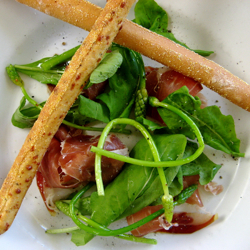
In early 2007, Pawlcyn launched what is now her largest outpost: Go Fish. A “West Coast seafood house” along Highway 29, Go Fish is paradoxically cavernous but cozy, a coup that owes much to successful decor and lighting. The menu includes both traditional and modern seafood plates, but — as you might expect from a kitchen under the auspices of sushi master Ken Tominaga — the raw fish options are its stunning centerpiece. We visited over the holiday and out of a dozen nigiri and a few specialty rolls we sampled, only one (the kitchen’s very last portion of ikura, which we should have known better than to pounce upon) was less than sublime.
As lovely as Go Fish is, though, it’s too dear for everyday. It’s all too easy to spend hundreds of dollars on dinner for two, especially if you make a meal of the amazing sushi… which I highly suggest you do. Happily, there are many different ways to experience the inspired cuisine of the other — one might even say the original — Napa dining dynasty.

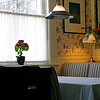
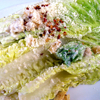
Cindy’s Backstreet Kitchen
1327 Railroad Avenue
St. Helena, CA 94574
707.963-1200
Go Fish
641 Main Street
St. Helena, CA 94574
707.963-0700
Mustards Grill
7399 St. Helena Highway
Yountville, CA 94558
707.944-2424
cookbooks, Napa & Sonoma, restaurants
5 Comments »
Posted by Anita on 06.24.07 8:07 PM
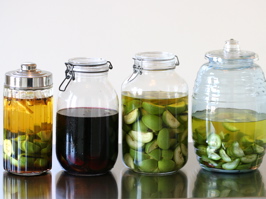 Every June 24, Catholics around the globe celebrate the feast-day of John the Baptist. And every year, on that same day, traditional-minded Europeans head into their local walnut orchards, filling baskets and bags with unripe nuts in order to make nocino, an Italian walnut liqueur, or its French cousin vin de noix.
We’ve made nocino every summer for the past three years, usually a bit later than the traditional saint’s day due to trouble in our local supply chain. Suffice to say that we lack the necessary ferme, fattoria, or bucolic farmhouse of any sort, and we’ve relied either on nuts shipped from afar or the whimsical schedule of a certain vendor at the Alemany market.
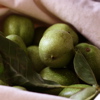
This year, we not only avoided our usual delay, we even jumped the gun a bit. But I hope you’ll agree our motives were good: We were off to Yountville for our anniversary, and I’d remembered reading Shuna’s story last fall about Hoffman Farm, a Napa u-pick with a vast walnut orchard. The idea of making liqueur with nuts we’d plucked ourselves from local trees was simply too attractive to pass up, no matter the date was a tad early.
It took me days to work up the nerve to call John Hoffman and explain what I had in mind. He’d never heard of anyone wanting green walnuts before. “You do know they’re incredibly bitter?” he asked me on the phone. But he graciously allowed that we might stop the coming weekend and pick some nuts, as long as we didn’t come on Sunday morning during church. I assured him that we’d work around his schedule, and would be sure to call before we came, in any case.
Saturday rolled around, bright and sunny. We called Mr. Hoffman to make sure he was home, then donned hats and sunscreen and pointed the car toward Silverado Highway. Just past the intersection with Trancas, we spied the farm’s little sign, a blink-and-miss-it affair. We pulled up the gravel drive and found Mr. Hoffman waiting for us in the shade near his farmhouse garage.
We introduced ourselves and chatted a bit, and he asked me to remind him about what I would do with my early harvest. I explained about splitting the nuts and soaking them in alcohol for most of the summer, then setting aside the strained, sweetened infusion until Christmastime. I marveled that a walnut farmer — and one with Italian in-laws, at that — had never tasted what I’d always assumed was a relatively common homebrew. Not only had he never made it, he’d never even heard of it. Chuckling, he quipped: “Sounds like a waste of a good bottle of vodka,” and winked at Cameron.
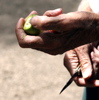
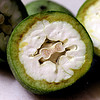
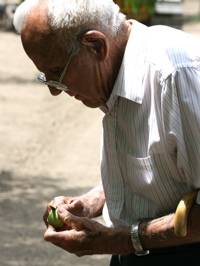 Then he picked up his cane and strolled us out into the orchard. A sun-dappled canopy of walnut boughs stretched as far as the eye could see, all the way back to the crossroads. Mr. Hoffman showed us how to avoid the nuts that suffered from blight — they were few, this early in the season — and how to spy the telltale bore holes of caterpillar infestation. He reached for his pocketknife and cut open one of the few rotten nuts he could find, to show me how the fungus penetrates the hull and works its way to the developing meat.
It was a botany tutorial, a history lesson, and a glimpse at a disappearing way of life. The Hoffmans have worked this land since the end of World War II. Now, they’re farming one of Napa’s few remaining diversified acreages, as vineyards squeeze out the fruits and nuts that once were the valley’s pride. As Shuna mentions, although the Hoffman land is protected for agricultural use, there’s nothing to prevent these noble trees from being torn out in favor of yet another mass of wine grapes.
After a half hour of picking nuts and snapping photos in the late-morning glow, we brought our canvas sack back to the garage. Mr. Hoffman discussed how to price our unusual transaction while he weighed our haul on his weathered scale. When all was said and done, he refused to take more than a fraction of what we’re used to paying, even when we told him that the going rate was much, much higher. He shook his head like we were citified fools, then added: “You can keep the quarters if you tell me that recipe again.” I smiled broadly and promised to send him prints of the photos we’d taken, plus a few different recipes to try.
We grinned all the way home, amazed at our good fortune in finding Mr. Hoffman — all thanks to Shuna.
After stopping by the local liquor depot for bottles of 100-proof vodka, I quickly set to work halving and quartering the green nuts, measuring sweeteners and spices, and sterilizing my infusing jars. Never had I had the luxury of using nuts picked within hours of infusing, much less 7 pounds worth gathered with my own two hands. Unsurprisingly, we had sufficient nuts for two different batches of nocino — my usual recipe, plus an experiment — as well as a version of Abra’s traditional vin de noix and Lucy’s lighter recipe made with white Burgundy and maple syrup.
I left my quartet of crockery on the new breakfast table for a day or two; they caught the light so beautifully that I wanted to see them (and sneak a sniff of them) all the time. Once the liquids steeped to a black-hole opacity, I followed tradition and put them out in the garden — in this case, the back deck — where they’ll commune with nature for the next 40 days and 40 nights. Then we’ll filter them, bottle them, and wait for the other end of the year, when midwinter brings us yet another celebration of the natural cycle disguised as a religious feast.


Hoffman Farm
2125 Silverado Trail
Napa, CA 94558
707 226-8938
drinks, holidays & occasions, Italian, locavore, Napa & Sonoma, preserving & infusing
13 Comments »
Posted by Anita on 06.08.07 12:43 PM

We’ll be away from the blog for a few days. We have an occasion to celebrate, and dinner reservations at a special place tonight. (Please forgive the photo — it was the best of the roll from our last visit in 2005!)
I’m stunned to realize that it’s been more than two years since we visited Wine Country. Is it possible we haven’t been back since we left Seattle? That’s almost as hard as it is to believe that it’s been five whole years ago since we were married, just on the other side of the hills in Sonoma County.
Have a great weekend. I know we will!
holidays & occasions, Napa & Sonoma, restaurants
9 Comments »
